Friday, July 26, 2013

Avoid the DEET and Look to Nature for Bug Repellant!

If you haven’t noticed, the mosquitoes are out in droves this summer. Mainstream repellents are quite toxic not only to the skin, but to the neurological and endocrine systems as well.
Nature is a great place to look for natural ways to thwart the mosquitoes and no-see-ums, that seem to amass in clouds this year. 
Consider Limonene. What? If you have ever peeled an orange, no doubt you have “been exposed” to the organic chemical - limonene.  Scrape an orange peel and smell your fingers... limonene is a chemical released from the peel that produces a very strong citrus smell. Per NakedScientists.com “the reason that fruit, citrus in particular, make the chemical is because it’s also quite nasty for things, other  than humans, who haven’t got fingers to peel an orange.  If you try to borough through the peel of an orange, you’d have to eat the peel and the peel doesn’t taste too good.  Limonene is mildly toxic and being organic and unpleasant tasting as it is, it puts off insects...a way (fruit) tree uses in keeping its fruit in good condition."
Our family stocks up on the all natural citrus scents of AB botanical citrus aromatherapy line during the summer. The mist awakens my senses with key ingredients such as lemon peel, and essential oils from coriander and limonene.
A friend of mine, who is a new mom,  swears by that citrus aromatherapy that is pure and safe (one most know and trust the brands they choose for their family)  found in her summer arsenal of safe baby care products. Although green science botanical products are not going to provide a 10 ft. shield from bugs, and insects may still hover near human skin, my friend stated that her new baby has not been bit once despite the bugs being around in great supply.
Although natural aromatherapy lines arfe not sold or guaranteed as an insect repellant, many find they work. For my daughter, a mist alone repels. I personally prefer to double my defenses, and apply the citrus fragrant body  lotion first, on my skin, whether exposed or not as those “skeeters” have a nasty habit of biting through lightweight summer material. I then follow with the citrus mist, which also serves as a refreshing afternoon pick-me-up or freshener after a work out. I take the mist along to an outing to reapply as needed.
If you have been applying toxic chemicals, because you figure it is a better alternative than perhaps getting Lyme's disease, you may want to study the side effects of Deet and other harmful insect repellant ingredients. All pesticides are endocrine disruptors, and contribute to hormone imbalance with a lean towards estrogen dominance.  Consider purchasing a mosquito net. I did just that this summer!
For more on the harmful effects of sprays containing DEET check out this article, and then consider whether we might learn from nature, and the natural insect repellents of the natural world.

To your health,
Rita S.

Monday, July 22, 2013

Summertime Friend or Foe: Chlorinated Water

Most agree that swimming is good  exercise.  Swimming is therapeutic as well, and of course it’s a great way to cool of during these hot days of summer. Public pools, and for most of us, even the backyard pool, utilize chemicals to maintain and sanitize the pool water. Chlorine is most commonly used, and poses a risk to our health as well. It seems to be a Catch 22. It seems if we want to swim in water with a balanced pH, we have to subject our bodies to hazardous chemicals.

Per Dr. Joe Mercola, a well known health advocate whom authors the most popular health web site on the internet, writes: “Chlorine is a hazardous chemical when absorbed by your body or inhaled. Most public pools are overloaded with chlorine, as the well-intentioned people who maintain public pools overly shock them with chlorine to make sure bacteria and other organisms get snuffed out quickly. But even the swimming pool in your backyard could be toxic if you treat it with chlorine.”
Studies have pointed out risks to those working in and around chlorinated water, such as, swim instructors are twice as likely to suffer frequently from sinusitis or sore throat, and more than three times as likely to have chronic colds, than pool workers with less trichloramine exposure, such as waiters or receptionists. Compared to the general population, pool workers with high levels of exposure were at a 40% greater risk for tightness of the chest, and over 700% more likely to suffer breathlessness while walking. Chlorine in pools poses the risk of miscarriage and stillbirths in pregnant women, and birth defects. It can weaken the immune system, disrupt central nervous system, damage the cardiovascular system, and more, per Mercola’s article.
Swimming is a great recreation, and should be encouraged, but take some actions to reduce chlorinic overload on your body. For a number of years our family had a backyard EasySet pool.  Learning about the toxicity of chlorine, we learned that Patio Pleasures Pools and Spas in Madison offered a “green chemical” that was a more safe alternative than chlorine. Our family really enjoyed pool time not having the sting of chlorine in the eyes.
We use an AB Detox Rescue Wash (for head to toe cleaning), whic contains sea algae extracts in a sulfate-free cleanser to provide antioxidant benefits to help neutralize the toxicity of heavy metals (e.g. lead, mercury  chromium and cadmium).
Research indicates that heavy metal build-up can lead to poor digestion, hormonal imbalance and depression. The unique formula lifts away impurities and environmental toxins and also provides a moisture barrier on the skin’s surface to provide a relaxed, and comfortable feel. The item number for this product is 7320.
Hair care products developed for chemically treated hair,  free of parabens, SLS and other harmful or irritating ingredients, can help combat the effects of chlorine. Learn to become your own ingredient watchdog, as shampoos and conditioners are some of the most toxic hygiene products on the market, yet we apply them on our scalp - right above our brain (now, that is a scary thought!).  If hairs get especially tangled after hours in a pool, a quality hair mask can also be of great help in repairing chemically damaged hairs after being washed, in addition to smoothinig out tangles and restoring softness.

Saturday, July 20, 2013

Summer Fresh Produce Helps Avoid Processed Nasties

Summer is the perfect time to focus on healthier lifestyles. Farmer’s markets and   fresh produce abound, making it easier to   incorporate fresh and whole foods into your eating plan.

To lose weight, or for more energy, shopping around the OUTSIDE of the grocery store is the most assured way of shedding unwanted pounds.  This time of year consider shopping for produce at the markets to help sustain local farmers and growers. In today's fast paced world, that is not always possible. Here are a few ingredients to be aware of and avoid as much as possible when grocery shopping.

- High fructose corn syrup (even grain breads contain HFS)
- MSG or glutamates
- Partially hydrogenated oils (worse than trans fats)
- Aspartame, surcralose and other artificial sweeteners

HFS and MSG both not only contribute to weight gain and cravings, studies reveal these ingredients are being linked to serious disease, including cancer.

Margarine is NOT your friend.  A recommended read is "Good Calories, Bad Calories" by Gary Taubes.

Beware of "low-fat" foods.  To make up for the taste of removing the fat, food manufacturers load these foods with artificial sweeteners, corn syrups and "ose" words. High fructose corn syrup is a GMO product (genetically modified organism). Corn and soybean crops grown in the U.S., unless organic, are GMO, and what that means for you and me is that the end result food product messes with our endocrine system, and thereby creates a hormone imbalance.

Fructose is sugar derived from fruit, and although it should be  limited in the diet, it is a healthier choice long term than an artificial sweetener. (Unless you have cancer, in which case all sugars and artificial sweeteners should be avoided as they fuel cancer cells, per Dr. Russel Blaylock, renown neurosurgeon and author of Excitotoxins: The Taste That Kills.)

A note that may shock some...regular soda, is a "more healthy" choice than diet-soda; because of the artificial sweetener content. Although it is pretty much guaranteed that if a person drinks soda daily, and kicks the habit, they would easily drop at least 10 lbs. in a month's time, likely more. Remember, in this paragraph, healthy is relative. Soda is never a HEALTHY choice of refreshment. It is toxic to your body, but regular is better than diet free. Just saying...

Avoiding these nasty ingredients alone is a step in the right direction for a healthier, and
happier you. Sometimes we need to start with baby steps before we can take leaps and bounds in living a more healthful and energetic life.

To your health,
Rita S.


Thursday, June 27, 2013

Gluten Free Hard Tack - Attempt Number Three

Welcome back. If you are reading this you either just now stumbled upon my blog, or you are returning to see how my third attempt at making gluten free hard tack has turned out.

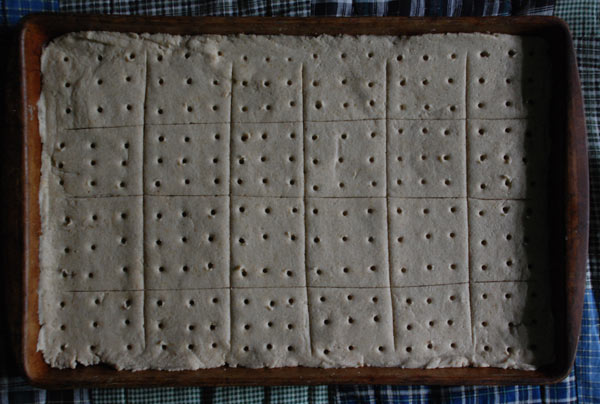
This time around, I decided to go for the "roll out" tradition of hardtack dough. The dough worked nicely for simply rolling out into a stoneware jelly roll pan with a small rolling pin, with a piece of parchment on top. First, I will admit that I used three teaspoons of salt, going for the "saltine cracker"-like imitation, and knowing our son is going to be sweating bullets playing soldier out in Gettysburg, and his body will lose necessary salt and iodine with that very physical activity in heat and humidity. TOO MUCH salt, in my opinion, although both of our kids think it tastes good. Go figure...

The dry ingredients are as follows, sift/stir together:
3/4 cup  rice flour
1/2 cup arrowroot starch
1 1/2 cups almond flour
1 1/2 cups sweet sorghum flour
1-2 teaspoons Celtic sea salt, fine (depending on salty preference)

In 1 cup measuring cup lightly whisk together:
1/2 cup water
1 T. agave nectar, or honey
1 T. coconut oil - melted

Slowly pour the wet ingredients into the dry ingredients, blending with wooden spoon, until a ball of dough forms. Place ball of dough on a cool or cold baking stone, seasoned with oil if necessary.
Place parchment paper over the dough, and use a small rolling pin to roll out into jelly roll bar pan.

The ingenious part - BEFORE baking use a pizza cutter to make 3" squares (or there about). Use a chopstick, or what have you, to poke 9 holes into each square - somewhat symetrically.  Bake for 20 min. at 350 degree or until lightly golden.  
We are starting to pack suitcases for Gettysburg. I reserved tickets for the grand opening of Seminary Ridge Museum today  -they are selling out fast so be warned! I am hoping the tons of rain they are getting out east as well won't make for a muddy mess, ie. spectators vehicles getting stuck in the mud. I could see that happening to the trucks bringing in all the cannons, too!

Non hardtack related:
Sometimes I'm an ingenious mother....I bought a diabetic insulin travel kit from amazon.com - which has a spot for an ice pack in the lid. It is black and blends in perfectly with Kyle's black Civil War haversack, and tucks inside nicely as well. In it will be essentials for dealing with heat and humidity while dressed in wool from head to toe in Gettysburg, re-enacting battles in the swelter. AB lip saver with spf of 30, COOLING SeeSource Body Gelee to help deal with heat exhaustion, cool the body down and relieve aches, Fizz Energy drinks with complex Vit B, guarana and taurine for focus and energy (without the harmful artificial ingredients typical of the energy drink market), a wet and cold wash cloth (in Union blue) inside a baggie to use as a compress. It takes up little space, and an outside pocket can keep his "marching orders" secure.

We are getting set to experience HISTORY coming alive - even our 10 yr old daughter is getting excited at the prospect - opening her mind to history and realizing there is more to life than math, science and writing.

To your health,
Rita S.

Saturday, June 22, 2013

Gluten Free Hardtack for the Gettysburg 150th

For more than a year now my family, my family and I have been making plans for our 2013 summer family vacation to Gettysburg for the 150th commemorative celebration.  Our son is a re-enactor with the 2nd Wisconsin Infantry, Company K - part of the "elite" Iron Brigade - as he likes to refer to the men in black hats.

Since we began making plans, we have realized that gluten and dairy cause great inflammation for our son's sinuses, basically making him miserable. Thus, it has become my quest to come up with a gluten-free hardtack recipe - my first attempts being shared here.

I thought I could simply make a more bland version of the awesome paleo flat bread recipe I came up with months ago, posted in the history of this blog (search for recipes in the cloud tag and you will find it). You know... leave out the garlic, rosemary, thyme....season with sea salt only, and a bit of agave nectar.  I've never made crackers, and perhaps I should have looked up a hardtack recipe first, to get an idea of really how basic it is.  My error, I came to realize after the first attempt - was that I added eggs. Eggs were a rare commodity in the Civil War, if I understand correctly, there are no eggs in hardtack.

The first batch, which I poured into a 9x9 pan (thinking it would be easy to cut into 9ths for 3x3" sqaure standard issue hardtack - which is the size advertised on a sutler's web site) - rose a bit too much. Hardtack is approximately 1/4" thick and batch number one is nearer to a 1/2".  So no, it did not turn out to qualify a replica of hardtack, but what it reminds me of is a dense shortbread. We tested it and it is quite good with a spread of fruit preserves on top, or would be great as a shortbread with berries.

Back to the drawing board....liking the taste of experiment number one, and finding a hardtack recipe on line, I realized all that I should be adding for liquid is water. Figuring I really could not mess up a gluten free staple too badly, I went ahead and increased my recipe so it would work in a large stoneware bar or jelly roll pan (mine is a well seasoned Pampered Chef brand).

If you have a solider that requires gluten free hardtack, give this a try. It may not be authentic, but it won't inflame, and it probably tastes a lot better as well.  After all, the Union has been reinstated and our "soldiers" may as well enjoy their modern day hardtack, if only a little.

GLUTEN FREE HARDTACK
Dry ingredients, blend together in a bowl:
3/4 c. brown rice flour
3/4 c. arrowroot starch
1 1/2 c. almond flour
1 1/2 c. sweet sorghum flour (coconut can be used, but the sweetness of sorghum is nice)
1 t. aluminum free baking powder
2-3 t. finely ground Celtic or Himilayan seasalt


In large bowl lightly whisk together:
1/2 cup of water
1 T agave nectar or honey (optional)
1 T. coconut oil - warmed to liquid state

Using a wooden spoon, slowly blend in the dry ingredients. Add 1/2 cup more of water, or that needed to create a pancake-like batter. Pour into a lightly greased (coconut oil recommended) or seasoned stoneware pan. It should self-level, but if not use a spatula to help spread evenly in pan.

Bake at 350 degrees for 5 minutes, or just long enough so batter is slightly set to allow poking of holes for an authentic appearance. My understanding is that a 3x3 piece of hardtack has 9 holes - originally created by a block of wood with screws.  Return to oven to bake for another 20 minutes. Allow to cool completely, cut into 3 inch squares.

If making gluten free hardtack becomes more frequent around here I will have my husband create a block of wood with screws for quick "hole making".

Our batch has a bit more crackling on top, and after the fact I learned that poking holes prevents this. My recipe above is altered from my original, removing in 5 min. versus 10 to poke the holes. I  learned the reason crackers have holes is to prevent the crackling on top. Par-baking  just enough so that holes can be poked, and the batter won't resettle to fill the holes back in, should do the trick.

I will soon be creating a third attempt, omitting baking powder, because of course I keep searching for hardtack recipes and learning more.  Less water, and rolling it out next time...so stay tuned.

Meanwhile, if you are heading to Gettysburg next week and need some gluten-free hardtack for your soldier - this tastes pretty good. ALSO, it is a complex carb, and should be low glycemic and a decent snack for someone dealing with diabetes, but I can't guarantee that.

To your gluten-free heatlh,
Rita S.

Sunday, June 2, 2013

Are the chemicals in your Acne Treatment okay?

If you are a user of acne treatment products that use BENZOYL PEROXIDE (BPO), you may find the linens in your linen closet riddled with white spots, or bleached areas. I have heard many complain about the ruining of towels, pillowcases, sheets, from benzoyl peroxide.

Food for thought for today - if a chemical in skin care bleaches your fabrics, do you feel it is safe for your skin and body?  Personally, I am not saying it is dangerous, but think about that for a moment....

For my own family, we have found a product line of which the active ingredient is salisylic acid, formulated with other botanicals, for an effective, non irritating treatment of facial acne. Abbi, above is one person who has benefited from the product line and saw visible results within a few weeks.

Benzoyl Peroxide, found in the most popular acne treatment product line advertised on television today, can irritate the skin of many - leaving it very dry. I've talked to a number of teens who dread using their acne treatment products because it makes their skin feel so dry and itchy, yet they don't want blemishes, or they are "threatened" by a parent who invested in the product, i.e. "use it or else..."

The top-selling brand, ProActive, when asked why they do not use BPO in their acne treatment products targeted for the body, state on their site why they utilize BPO only in the face products:
 "...Because BPO is known to bleach fabrics, while salicylic acid does not, we opted to leave it to our customers to decide whether they want to take the extra care required when using BPO products on the body. If you decide to take that route, we recommend that you wear white clothing, use white towels and sleep on white sheets; or at a minimum, wear a white T-shirt under your clothing and sleep in nightwear you don't care about bleaching so that the treated areas of your body don't make contact with your sheets." 

Now, I know people prefer studies about such ingredients, and I found one on BPO done way back in 2002. I am sure if I kept looking I would find some additional info uncovered by now. If you read the study, in general, you wouldn't get too concerned. (if you don't have concern for a chemical that bleaches your towels is ok for your body) ... http://www.chem.unep.ch/irptc/sids/oecdsids/BENZOYLPER.pdf

I did find this sentence on page 18 a bit disconcerting: "Benzoyl peroxide is not likely to be a complete carcinogen and/or initiator, but it seems to be a tumor promoter in mouse skin in an experimental two-stage model of carcinogenesis."

In my mind, an "INCOMPLETE carcinogen" is not okay...nor are tumor promoters. Obviously, doses of BPO at each application must be small, or people everywhere would have serious reactions to products using BPO. From the books and articles on endocrine disruptors that I have read, it is not the small amount in each "dose", but the build up of these chemicals in the body over a period of time, that contribute to problems down the line. I would venture a geuss that most people who use ProActive use if for more than a year, as they go through their hormonal change/teenage years.  As a parent, I am glad I can offer our son a safe approach to acne treatment.

A few other interesting google search finds on BPO - a hazardous material handling sheet on Benzoyl Peroxide from the US Department of Labor.
Holy cow Batman!  Why is this an okay ingredient to apply to our children's skin day in, day out?

When BPO was first scrutinized at its introduction to the market (whatever that may entail),  the FDA  classified Benzoyl Peroxide as a Category 1 chemical, in other words, safe to use.  However, in 1991 the FDA took another look at BPO and changed the chemical to a Category 3 "more data needed"  due to it's tumor promoting tendencies in more than one strain of mice, as well as in hamsters.  

This time of year, many are preparing for their wedding day, desperately trying to clear up blemishes and such prior to the big day when photos will be taken that will be with them the rest of their lives. As well, upcoming seniors often have their senior pictures taken during the summer prior to their last year of high school. I encourage parents to research the products they decide to purchase for their child, or encourage their young adult to be aware that ingredients in acne treatment products can and may:
1. turn your linens into a white dot design pattern
2. dry out and irritate skin, making them regret having to use it
3. can potentially be harmful with use

Safe and effective products are available, and some even come with a 45 day money back guarantee. As always, for the sake of your health, I hope you have found today's post informative and empowering to help you make smarter choices for smarter living, that can help you...

Feel better, look better, and live better!
Rita S.


Monday, April 29, 2013

Sunshine on My Shoulders Makes Me Happy (for a reason!)

This past weekend I was routed through the Denver, Colorado airport on the way to Vegas for an amazing and transforming weekend with the health and wellness company I consult for, through which I am building my dream life. While in the Deniver airport...John Denver could be heard in just about every store - "Rocky Mountain High", "Sunshine on My Shoulders"...and I got to thinking...
There is a biological reason that sunshine on one's shoulders "makes me happy" - sunshine provides the very necessary Vitamin D3 - which scientists are not recognizing as an actual hormone versus a "vitamin". Which in of itself is interesting...  
Dr. Russell Blaylock has written extensively, in  recent issues of his wellness newsletter, on the topic of anxiety and depression. A commonality, per Blaylock, is a deficiency in Vitamin D.  Therefore, if one has enough Vitamin D3 - the opposite of depression would be "happy". The sunshine vitamin = a dose of happy vitamin.
Here in Wisconsin, winter is cold, lacks sunshine, and the gray skies take a toll on people - S.A.D. (seasonal affective disorder) becomes more common. This past winter I heard stories from at least 6 people I know whom developed this. I knew my company was likely formulating a Vitamin D spray - I only wished I had it in my hands for those dear to me who were affected - and we had such a LONG winter, too. You can learn more about S.A.D. here.
Dr. Joe Mercola wrote an article, "Vitamin D is VITAL for You - and Your Family", in which he goes into great detail on the benefits of Vitamin D. I will sum it up with his key bullet pointed benefits:
- Heart Health
- Cell formation and longevity
- Skin health
- Pancreatic health
- Aging process
- Sleep patterns
- hearing
- Reproductive Health
- Eye health
- Athletic heatlh
- Vascular System health
- Respiratory Health
- Immune health
- healthy mood and feeling of well being
- Weight management, including carb and fat metabolism
- hair and hair follicles
- Strong healthy bones, as D encourages cacium uptake

Are you surprised to see muscles on the list? I admit I did not realize Vit. D3 was so important for so many biological functions.
Vitamin B12 should go hand in hand with D for maximum benefits. B12 is necessary for red blood cell formation, and helps alleviate chronic fatigue.
I hope this sheds some LIGHT on the topic of the necesisty for Vitamin D., and B12, too!  If you can't get a little sunshine on your shoulders for 15-20 min. per day (no sunscreen, no clothing to cover), you may want to have your levels checked and determine if supplementation may be to your benefit. According to Dr. Gominak, and his report found here, we would need to drink 100 cups of milk per day to get the Vitamin D we need. In fact, after reading that article, I do believe I need to go spray a bit of Essnetial Vitamin D/B12 into my mouth. It will be absorbed quickly, and I just may have the best night's sleep ever!

To your health!
Rita S.